

The procedures in this guide may be used for all files in the repository except the NHATS Restricted Genetics files. Researchers interested in using NHATS Restricted Genetics files (except for NHATS Restricted APOE files) should apply for NHATS Restricted Genetics files.
Centers for Medicare and Medicaid Services (CMS) files are not available through the NHATS Restricted Data Repository. Researchers interested in using CMS data (with or without Hospital Referral Region files or the Restricted Tracker Files) should apply for NHATS-CMS Linked Files.
Each application for access to the Restricted Data Repository will be reviewed by NHATS for conformance with the requirements outlined in the guide below. Each application must state specific research aims and work scope to be performed. The NHATS Restricted Data Repository does not accept umbrella applications for networks, centers, or other coordinating efforts. Questions regarding the application process may be sent to: [email protected]. Please use the subject heading: Application query (Investigator Name).
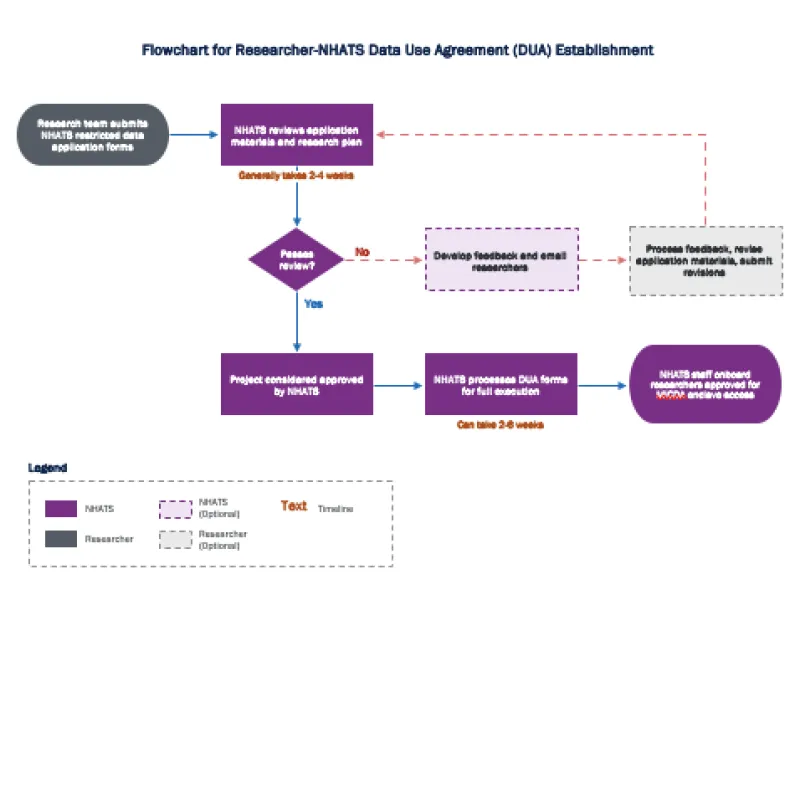
Steps to Accessing NHATS Restricted Data Files
For more information on the steps researchers need to take to access NHATS Restricted Data, excluding CMS or Genetics files, please consult the flow chart detailing processes.
Application Guide
I. The MiCDA Virtual Data Enclave
The MiCDA Virtual Data Enclave (VDE) provides remote access to the NHATS Restricted Data Repository through a virtual desktop infrastructure. Data remain on MiCDA enclave servers and are accessed and analyzed by approved users virtually via an encrypted connection. Please note that all results requested for export outside of the enclave must be reviewed for disclosure risks by NHATS staff.
Security measures.
Login to the enclave requires two‐factor authentication. Data files cannot enter or be removed from the NHATS repository by the researcher. Output and programs will be reviewed for disclosure risk by the repository director or their designee prior to removal. Users agree to access data only from locations specified in the MiCDA Data Security plan form. Users agree not to transcribe results as specified in MiCDA’s Secure Data Enclave Acceptable Use Policy and not to attempt to identify subjects as specified in the ISR Pledge of Confidentiality.
Software.
Each workstation is equipped with a suite of statistical software (including SAS, Stata, SPPS, MatLab, R, and Stat/Transfer) and Microsoft Office.
II. NHATS Restricted Data Repository Data Availability
Files available to approved users via the NHATS Restricted Data Repository include:
- NHATS Geographic Files
- NSOC Geographic Files
- NHATS SP-NHATS OP Distance Files
- NHATS SP-NSOC CG Distance Files
- NHATS Restricted Tracker Files
- NHATS 1940 Census Files
- NHATS 1940 Census Geographic Files
- NHATS COVID-19 Geographic File
- NHATS SP-NHATS COVID FF Distance File
- NHATS COVID-19 Restricted File
- NHATS Restricted APOE Files
Detail on files that may be requested is provided in Table 1. The NHATS Data Repository also includes a complete set of NSOC and NHATS sensitive files that may be requested. In addition, the repository includes all NHATS public use files.
NHATS Restricted APOE Files may not be linked to any other NHATS Restricted Files at this time.
Table 1. File Folders Available in the NHATS Restricted Data Repository
| File Folder | Description | Years available |
| NHATS Geographic Files (versions using 2010 and 2020 Census boundaries available) | Sample person’s city, state, county, zip code and census tract Sample person’s metro/non-metro status and RUCC1 Sample person’s Hospital Referral Region2 Sample person’s city, state living at age 15, country of birth if born outside of US Spouse/partner, child, and household member city, state | Annual SP Geographic Files Annual Metro files Annual HRR file Baseline SP files (e.g. 2011, 2015, 2022/2023) Annual OP Geographic Files |
| NSOC Geographic Files (versions using 2010 and 2020 Census boundaries available) | Caregiver’s city, state, county, zip code and census tract | 2011, 2015, 2017, 2021, 2022, 2023 |
| NHATS SP-NHATS OP Distance Files | Distance from NHATS SP to child Contains all records where op#relatnshp = 3 or 4 or 7 or 8 (children or step-children). Distance is rounded to the nearest mile and top-coded to 2500. Distance is calculated based on latitude/longitude values for the SP’s address and the centroid of the child’s city/state. | Annual files |
| NHATS SP-NSOC CG Distance Files | Distance from NHATS SP to NSOC caregiver Distance is rounded to the nearest mile and top-coded to 200. Distance is calculated based on latitude/longitude values for the SP’s address and the NSOC caregiver’s address. | 2011, 2015, 2017, 2021, 2022, 2023 |
| NHATS Restricted Tracker Files | Day NHATS interview conducted | Annual cumulative file |
| NHATS 1940 Census Files3 | Sample Person File with SP and Household Characteristics Other Person File | 2015 |
| NHATS 1940 Census Geographic Files | Geographic information below state (additional justification required) | 2015 |
| NHATS Long-Term Care Market Measures Files | County-level market measures reflecting the availability of long-term care services and supports in the United States | 2010-2020 |
| NHATS COVID-19 Geographic File | City, state, county, zip code and census tract of family members or friends who helped the NHATS Sample Person most during the COVID-19 outbreak. | 2020 |
| NHATS SP-NHATS COVID FF Distance File | Distance from NHATS SP to COVID FF Distance is rounded to the nearest mile and top-coded to 200. Distance is calculated based on latitude/ longitude values for the SP’s address and the COVID FF respondent’s address. | 2020 |
| NHATS Restricted COVID-19 File | Answers to open-ended question about how COVID has affected SP’s life | 2020 |
| NHATS Restricted APOE Files | An APOE haplotype and associated data constructed from imputed genetic data for NHATS SPs who provided dried blood spot-based DNA in Round 7 (2017). | 2017 |
1 The metro/non-metro indicators use the 2013 Rural-Urban Continuum Codes (RUCC). See https://www.ers.usda.gov/data-products/rural-urban-continuum-codes/ for details. Disaggregated RUCCs are available for each year; starting in round 14, the 2013 and 2023 RUCCs are available.
2 Developed by the Dartmouth Atlas of Health Care. See https://www.dartmouthatlas.org/data/ for details. This file lags other geographic files by about a year or two.
3 See https://usa.ipums.org/usa/voliii/items1940.shtml and https://nhats.org/sites/default/files/public-documentation/Linking_NHATS_to_1940_Census_Data_Final.pdf for details.
III. MiCDA Geographic Linkages Repository
Users may request to bring non-identifiable contextual files into the enclave via an approved research plan and NHATS Data Use Agreement (DUA). Users also may request access to folders in the MiCDA Geographic Linkages Repository (GLR) to link to NHATS/NSOC. See Table 2 for a current list of the file folders available in the MiCDA GLR. By requesting to use data deposited with GLR, users agree to cite any GLR data sources used in their publications and presentations. For more details, including citations, see micda.isr.umich.edu/enclave/linkages/.
Table 2. File Folders Available in the MiCDA Geographic Linkages Repository (GLR)
| File Folder | Description |
| Contextual Data Resource (CDR) | The Contextual Data Resource (CDR) is a collection of datasets designed to facilitate research on the role of place in shaping health and well-being. CDR includes measures of health care resources, demographic and socioeconomic data, air quality, crime, and the food environment. Measures are available at various levels of geography (e.g., census tract, county, metro area, state). More detailed information can be found on the CDR webpage. |
| Dartmouth Atlas of Health Care | These data document variations in how medical resources are distributed and used in the United States. The project uses Centers for Medicare and Medicaid Services (CMS) data to provide information and analysis about national, regional and local markets. Measures are available at various levels (e.g., Hospital Referral Region (HRR), Hospital Service Area (HSA), State and County) and for time periods starting in the 1990s. Each set of files includes a data dictionary. Data files focus on Medicare beneficiaries ages 65 and older. Visit https://www.dartmouthatlas.org/ or https://dataverse.dartmouth.edu/dataverse/atlas for further information. |
| Historic Redlining | These data are the Historic Redlining Indicator (HRI) created by the Mapping Inequality project as the summed proportion of the federal Home Owners’ Loan Corporation’s residential security grades multiplied by a weighting factor based on area within census tracts. A higher score means greater redlining of the census tract. The 1930s HOLC maps were calculated for 2000, 2010 and 2020 census tracts for 142 cities across the U.S. The data contain continuous HRIs and categorical variables as follows: 1 for “A” grade, 2 for “B” grade, 3 for “C” grade, and 4 for “D” grade. More information is available at the Mapping Inequality project website. |
| IPUMS Contextual Determinants of Health | The IPUMS Contextual Determinants of Health (CDOH) data files provide access to measures of disparities, policies, and counts, by state or county, for historically marginalized populations in the United States including Black, Asian, Hispanic/Latina/o/e/x, LGBTQ+ persons and women. |
| LTC focus database (LTCFocus) | The Long-Term Care Focus (LTCFocus) datasets include data regarding the health and functional status of nursing home residents, characteristics of care facilities, and data characterizing the markets in which facilities exist. Compiled data are gathered from a variety of primary and secondary sources, including MDS, OSCAR, and other sources that characterize the policy environment and local market forces affecting nursing home providers at the state and county level. Most measures are available annually from 2000 to 2020. Visit https://ltcfocus.org/ for additional information. |
| National Neighborhood Data Archive (NaNDA) | NaNDA is a nationwide collection of data with measures of the demographic, economic, social, and physical environments, generally at the level of Zip Code Tabulation Areas (ZCTA) and Census Tract. Measures cover socioeconomic and demographic data, urbanicity, broadband and internet access, establishments or organizations by type, health care services, crime, schools, parks, public transit stops, polluting sites, roadways, street connectivity, traffic volume, voter patterns. A Zip Code to ZCTA crosswalk is included. More detailed information can be found on the NaNDA webpage and at OpenICPSR. |
| State Education Context Data Resource (S-ECDR) | The S-ECDR captures 43 key analytic indicators of state-level education context and quality spanning 1919/20-1973/74. There are 4 linking variables (e.g., state FIPS code) that can be used to merge the S-ECDR to other datasets, 2 geographic variables (i.e., census region and division), 13 variables that adjust the dollar amounts in each year to 2022 prices using the Consumer Price Index (CPI), and 36 flag variables that indicate the state-years when missing values were imputed. |
| State Policy and Politics Database (SPPD) | The State Policy & Politics Database (SPPD) is a compilation of annual data on state policies and politics that are particularly relevant for population health. The SPPD includes several categories of policies, including labor and economic policies (e.g., minimum wage levels, right to work laws), social safety net policies (e.g., earned income tax credits, SNAP), behavior-related policies (e.g., tobacco taxes, opioid prescribing), as well as the political ideology of the states’ government and citizens. Most measures are available annually from 1980 to 2021. More detailed information can be found on the SPPD website. |
| U.S. COVID-19 County Policy (UCCP) Database | The U.S. COVID-19 County Policy (UCCP) Database presents and assesses geographic and longitudinal variation in U.S. COVID-19-related policies at the county and state levels for 309 counties in 50 states and Washington D.C. Although these counties are not nationally representative, they included over half of the U.S. population and are diverse with respect to geography, the race/ethnicity of residents, and political climate. Weekly data were collected between January 2020 and December 2021 on a wide range of COVID-19-related policies that were in effect, providing a longitudinal picture of county policies during that period. |
IV. NHATS Restricted Data Repository Applicants and Team Member Roles
Investigator (Applicant) Requirements
To be eligible to apply for NHATS Restricted Data, an Investigator must:
- have a PhD or other terminal degree (e.g. MD-MPH) and hold a full-time faculty-level (or equivalent research) appointment at a U.S.-based university or research institution, and
- be affiliated with an Institution that holds a Federal Wide Assurance (FWA) from the Office for Human Research Protection of the Department of Health and Human Services (see https://www.hhs.gov/ohrp/register-irbs-and-obtain-fwas/fwas/fwa-protection-of-human-subjecct/index.html)
Investigators collaborating at different institutions must have one Investigator at each institution who meets the qualifications to apply if both institutions are requesting access to the data through the MICDA enclave.
Pre‐doctoral students or post‐doctoral fellows interested in applying for access to NHATS restricted data must have their mentor/advisor apply as the Investigator (applicant) and may be listed as Research Staff on the application.
Roles for NHATS Restricted Data Repository Applications
- Investigator ‐ This individual is considered the Principal Investigator of the project and must meet all applicant requirements
- Co‐Investigator – This individual collaborates with the requesting Investigator and must hold a faculty‐level (or equivalent research) appointment at the Investigator’s institution
- Research Staff – This individual must have a formal affiliation with the Investigator’s institution and be under the supervision of the Investigator
- Receiving Agency Representative – This individual has authority to sign the NHATS Data Use Agreement (DUA) on behalf of the Investigator’s Institution. The representative must have the authority to bind the institution contractually and is typically found at the Investigator’s institution’s office of sponsored programs or projects.
- User – This individual is requesting an account in the MiCDA Virtual Data Enclave to access the NHATS Restricted Data Repository and may be the Investigator, Co‐Investigator or Research Staff listed on the application.
All Investigators, Co‐Investigators and Research Staff who will work with the NHATS Restricted data must be on an NHATS DUA, must be registered NHATS users (see https://www.nhats.org/user/register), and must have a formal affiliation with the Requesting Investigator’s institution.
Processes for Collaborating Investigators at Another Institution
A collaborating Investigator at another institution who wishes to access the NHATS Restricted Data Repository must submit a separate application (see Application Process).
The individual will be designated the Investigator for their institution and must meet all Investigator requirements. They may include additional Co-Investigators and Research Staff from their institution on their application. All Investigators, Co-Investigators and Research Staff at collaborating institutions who will work with the NHATS Restricted data must be on the collaborating Investigator’s DUA, must be registered NHATS users (see https://www.nhats.org/user/register), and must have a formal affiliation with the collaborating Investigator’s institution.
Research team members who move institutions are required to notify NHATS prior to the move. A new DUA with the new institution is required to maintain access to NHATS restricted data. User accounts will be suspended until a new DUA is executed.
V. Requirements for NHATS Restricted Data Repository Applications
Information on each required element of an application is discussed below.
Application Checklist
This form helps investigators keep track of the various elements required for the application. It also serves as an acknowledgement that the investigator (applicant) has ensured all research team members are registered NHATS users and that all research team members have read the rules regarding minimizing disclosure risk.
Investigator Form
This form is needed for our database. Please note that any changes in the contact information listed on this form should be communicated to [email protected]. NHATS does not accept umbrella applications for networks, centers, or other coordinating efforts.
- Project Forms and Documents
Project title and abstract
The project title, abstract, and research plan should reflect the same theme/aims for the project.
Research plan
Each application must state specific research aims and work scope to be performed. Detailed information on the study’s analytic sample, expected sample sizes, variables/constructs, and need for restricted data is required.
Research plans are reviewed for feasibility with respect to expected sample size and appropriateness of requested data to answer the research aims.
Applicants are encouraged to seek out information on the NHATS.org website to gain a sense of feasibility with respect to sample size. Applicants are also encouraged to read the restricted data disclosure minimization rules prior to submission of the research plan.
- CV or Biosketch for Investigator and Co‐Investigator(s)
Copy of full or expedited IRB approval
IRB/Human Subjects approval at the Investigator’s institution should use standards for live human subjects. IRB approval must be at either the Full or Expedited level; access to these data does not qualify as exempt secondary analysis. A memo explaining the type of human subjects review that is being requested by NHATS and the reasons for it is provided for use as needed.
File Request Form
Data that are requested on any file request forms should be closely linked to the research plan.
External File Linkage Request Form (if applicable)
Any data files that will be imported into the enclave need to be documented on an external file request form. They should also be closely linked to the research plan.
Signed copy of the NHATS Restricted Data Use Agreement (DUA)
Please read the DUA closely prior to signing. Principal investigators are not receiving agency representatives. Only research team members requesting enclave access need to be a party to the DUA. Research team members that do not need enclave access do not need to sign the DUA or other forms.
- Signed NHATS Supplemental Restricted Data Use Agreement with Research Staff (if applicable)
- Investigators Collaborating Across Institutions (if applicable)
Project Forms and Documents for each Investigator listed
Investigators collaborating at different institutions must each complete a separate application with a common title, file request form, and research plan. A separate DUA and IRB approval (or proof that another institution serves as the IRB of record) is required for each institution. Only individuals at the applicant’s own institution should be listed as Co-Investigators, Research Staff or users on a given application.
List of Users Requesting Enclave Access
All PIs must request access to the enclave.
- For each user:
A Data Security Plan
Elements of the Data Protection Plan
- Currently supported Operating System
- Anti-virus software (even for Macs)
- Affirmation that the computer monitor position prevents eavesdropping (private office preferred)
- A privacy screen if accessing the Enclave from a shared office, a cubicle, or other shared workspace
- The address from which connections to the Enclave will be made
- Telephone number at which DUO (dual factor authentication system) can call the researcher
- Signed MiCDA Acceptable Use Policy Agreement
- Signed NHATS Acceptable Use Policy Agreement
VI. Application Process
A flowchart of the steps is located here. The application process requires the following steps:
Step 1: Complete and sign the required forms and documents. Be sure all individuals listed on the NHATS DUA are registered NHATS users (see https://www.nhats.org/user/register).
Step 2: Submit the application materials electronically to [email protected] using the subject heading: Restricted Data Application (Investigator Name).
Step 3: NHATS will review the documents submitted. Any questions, or needed revisions, will be communicated to the Requesting Investigator.
Step 4: Once NHATS approves the application, the DUA will be countersigned by NHATS and Johns Hopkins University. MiCDA accounts will then be set up and users will be given access to files in the DUA. A fully executed DUA will be sent to the applicant along with instructions on how to log into the MiCDA Virtual Data Enclave.