

Older adults who receive rides from family and friends are more than twice as likely to have quit driving three years later compared with those not getting transportation help, a new study found.1 Accessible public transportation, paratransit services for people with disabilities or limitations, and rideshare companies such as Uber and Lyft could help reduce the time family and friends spend providing assistance, another team of researchers suggests.2
Using National Health and Aging Trends Study (NHATS) data, researchers from the University of Wisconsin-Madison (UW-Madison) analyzed a nationally representative sample of more than 5,000 U.S. drivers ages 65 and older in 2015 and 2018. Those receiving rides from family and friends in 2015 were twice as likely to have given up their car keys by 2018 than those who did not get rides. But having family and close friends living nearby—and potentially able to offer rides—did not increase the likelihood that older adults gave up driving, they found.
The Transition to Giving Up Driving Can Be a Continuum
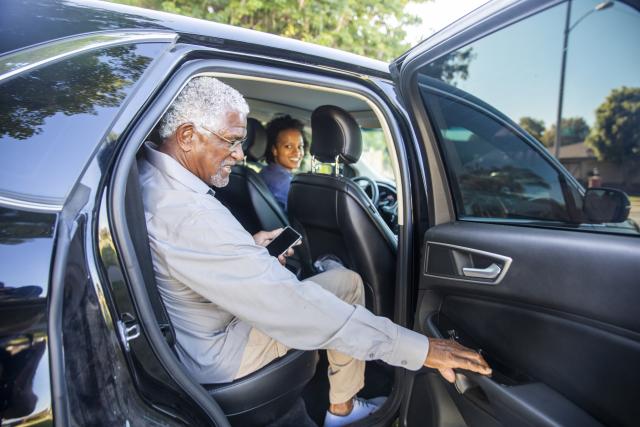
The road to becoming a non-driver is complex: Older adults often begin regulating their driving gradually by avoiding driving at night or in bad weather and asking others for rides, UW-Madison’s Kellia J. Hansmann, Ronald Gangnon, Carolyn McAndrews, and Stephanie A. Robert explain.
But rapid changes in an older adults’ health and function can lead to an abrupt decision to hang up the car keys. These changes can include cognitive decline in the context of dementia, changes in physical function related to strokes or other medical conditions, and severe vision impairment such as glaucoma, according to Hansmann.
Other studies have shown that giving up driving can increase an older person’s risk of depression and social isolation, which can take a toll on health and hasten death, they report. Their findings underscore the importance of helping “older adults prepare for and navigate the transition to non-driving” by supporting friends and family who provide an important alternative to avoid risky driving situations and maintain their mobility and social connections within the community, the researchers write.
Family and Friends Who Provide Rides More Regularly Tend to Put in the Most Caregiving Hours
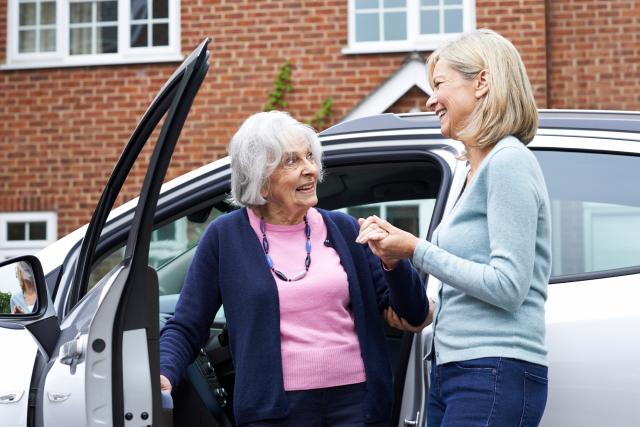
Caregivers providing frequent transportation assistance were more likely to provide a high total number of caregiving hours, report Athena Koumoutzis and Jonathon M. Vivoda of Miami University of Ohio, and Jiawei Cao of Nanjing University of Medicine, China.
The team analyzed 2017 NHATS data from more than 1,000 pairs of older adults ages 65 and older and their unpaid care providers. Caregivers who provided daily transportation assistance and care recipients who hadn't driven recently reported the highest number of caregiving hours, roughly six hours daily. Care recipients who drove frequently tended to be among those receiving the fewest hours of care from unpaid family and friends, under three hours daily.
The study highlights the key role transportation plays in shaping overall caregiving hours. The authors suggest that familiarity with accessible alternative transportation sources—public buses or ride share services—could potentially lessen demands on family and friends providing informal care.
1 Kellia J. Hansmann, Ronald Gangnon, Carolyn McAndrews, and Stephanie A. Robert, “Getting Rides From Others as a Coping Mechanism in the Transition to Non-Driving,” The Journals of Gerontology. Series B, Psychological Sciences and Social Sciences vol. 79,6 (2024): gbae054. https://doi.org/10.1093/geronb/gbae054
2 Athena Koumoutzis, Jonathon M. Vivoda, and Jiawei Cao, “With a Little Help From My Friends and Family: Transportation and Caregiving Hours.” Journal of Applied Gerontology: The Official Journal of the Southern Gerontological Society vol. 41,8 (2022): 1914-23. https://doi.org/10.1177/07334648221089624
The National Health and Aging Trends Study and National Study of Caregiving are funded by a grant from the National Institute on Aging (U01AG032947).