

Characteristics of America’s unpaid family caregivers and the support they provide to older adults have remained largely static over the last decade (2011 to 2023). However, the nation’s unpaid caregivers are themselves aging, and a growing share are friends or neighbors rather than kin, according to more than a decade of data (2011 to 2023) from the National Study of Caregiving.
New analysis highlights ten facts underscoring both stability and change in family caregivers’ lives and the types of tasks they undertake as they assist the nation’s growing older population.
Stable features of U.S. family caregivers and the family caregiver experience:

Women continue to make up nearly two-thirds of caregivers and about 4 out of 10 family caregivers work for pay.
The share with minor children remained fairly stable at 14-15%. Those older adult caregivers with a child under age 18 are referred to as sandwich caregivers due to their juggling of responsibilities for both age groups.
The majority of family caregivers live with the care recipient or within 10 minutes. In both years roughly 45% of family caregivers lived with the older adult and another 25% within 10 minutes.
The share of caregivers helping with many key tasks changed very little: The percentage providing assistance with self-care activities (such as bathing and dressing) was 52% in 2023; mobility activities (such as getting around inside and out) was 70% in 2023; and household activities (such as grocery shopping or laundry) was 95% in 2023. Caregivers’ participation in other activities was also stable during the period including tracking medications (47% in 2023), assisting with any medical care activities (defined broadly to include managing medications, giving shots or injections, communicating with providers, etc.; 79% in 2023), or assistance with skin care related to wounds or sores (20% in 2023).
The percentage of family caregivers providing 40 or more hours of care per week remained flat at 11% and the duration of caregiving remained stable: In 2023, 30% of family caregivers had assisted for 0 to 2 years; 33% for 3 to 5 years; and 36% for more than 5 years.
The levels of strain family caregivers reported did not change significantly between 2011 and 2023. In each year about 44% had none/very low strain, nearly one-third (32%) had low strain and about one in four (24%) had moderate or high strain.
Notable changes among U.S. family caregivers include:

On average, the population of U.S. family caregivers is older than a decade ago. The percentage of family caregivers that were under age 55 declined from 42% in 2011 to 32% in 2023, a full 10 percentage point drop. But the share ages 65 to 74 and 75 and older increased (from 19% to 26% and from 13% to 18%, respectively).
The share of unpaid “family” caregivers who were friends or neighbors increased. Reflecting increases in the share of older adults without close kin, the percentage of family caregivers who were non-kin increased from 9% in 2011 to 12% in 2023
A growing share of family caregivers is spending fewer hours providing assistance. The percentage of family caregivers providing up to 10 hours of care per week increased from 55% in 2011 to 60% in 2023, while the percentage providing 11 to 39 hours per week declined from 33% to 29%.
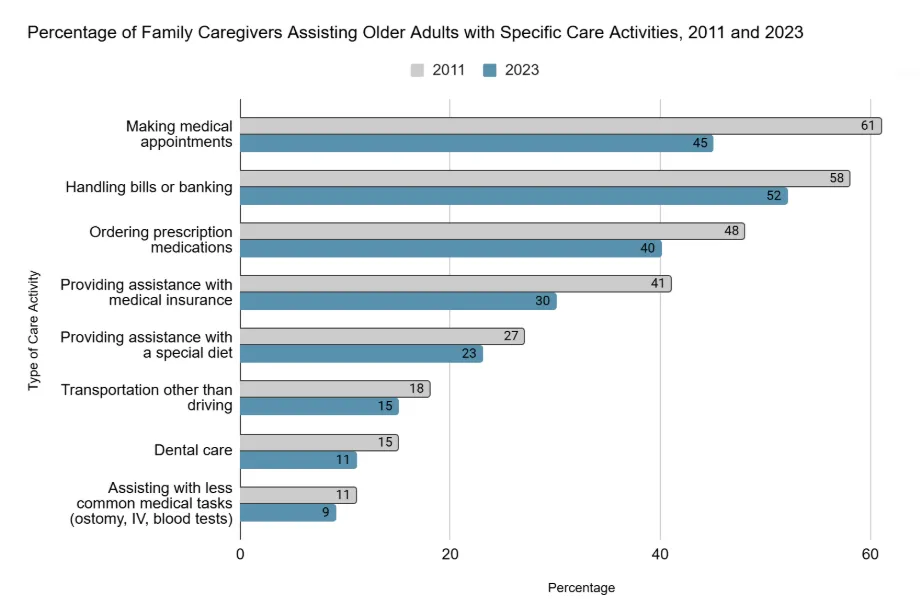
Family caregivers were less likely in 2023 than in 2011 to have assisted an older adult with the activities that may be carried out online (see Figure): making medical appointments, handling bills or banking, ordering prescription medications, and providing assistance with medical insurance. In addition, there were declines in the percentage assisting with a special diet, providing transportation other than driving, dental care, assistance with less common medical tasks (e.g., ostomy, IV, blood tests)
Begun in 2011, the NSOC interviews family caregivers of participants in the National Health and Aging Trends Study (NHATS). NHATS gathers annual, in-person information on a nationally representative sample of Medicare beneficiaries ages 65 and older. The studies are designed to foster research that guides efforts to reduce disability, maximize health and independent functioning, and enhance quality of life at older ages for older adults and their caregivers. This analysis focuses on family care to older adults not living in nursing home settings.
The National Study of Caregiving is funded by grants from the National Institute on Aging (U01AG032947 and R01AG062477). For more information visit nhats.org/welcome.