

Disability has declined among Americans ages 72 and older, according to more than a decade of data (2011-2023) from the National Health and Aging Trends Study (NHATS). New analysis highlights 10 facts that together point to encouraging gains but also areas that require attention.
More Are Managing Independently but Some Aren’t Getting All the Help They Need at Home, New Analysis Shows
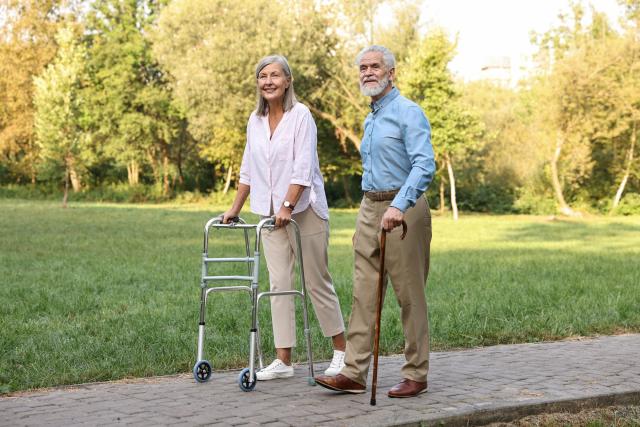
Older adults are more independent with the help of assistive devices. A larger share of older adults manages their daily care needs with assistive devices such as walkers, canes, and grab bars. The share using such devices successfully (and reporting no difficulty or need for assistance with daily care needs) increased from 31% in 2011 to 37% by 2023.
A larger share of older adults reports difficulty and unmet need for help with household tasks. Limitations related to health or physical functioning made household activities—like laundry and shopping for groceries–—difficult for 18% of those 72 and older in 2023, up from 13% in 2011. The share receiving help with household tasks declined during the period from 30% to 25%. A larger share reported negative consequences—such as going without clean clothes or groceries—because no one was there to help.
The share of older adults living with dementia has declined (through 2022). Those living with dementia in settings other than nursing homes declined from 12% of the 72 and older population in 2011 to 8% in 2022, with significant declines observed for those ages 80 and older. When nursing home residents are included, the decline in the share living with dementia is even larger, from about 14% in 2011 to 8% in 2022.
The percentage of older adults reporting poor physical capacity has dropped. The share of adults reporting poor physical capacity decreased from 26% in 2011 to 21% in 2023. Poor physical capacity includes those who are unable to carry out multiple upper and lower body functions such as walking several blocks; climbing stairs; or lifting or reaching overhead.
The percentage of older adults with poor hearing declined from 18% in 2011 to 13% in 2023. Poor hearing includes those who report being deaf and those unable, with a hearing aid if used, to hear well enough to use a telephone or carry on a conversation in a quiet room.
The portion of older adults with poor vision declined slightly over this period, from 11% in 2011 to 10% in 2023. (Poor vision includes those who report being blind and those unable, with glasses or contacts if used, to see well enough to recognize someone across the street, watch television across a room, or read newspaper print.)
A growing and overwhelming share of older adults live in the community in private homes and apartments. The percentage of the older population living in traditional community settings increased from 81% in 2011 to 85% in 2023. During the same time period, the share of older adults living in retirement or senior housing remained stable, but the share living in residential care facilities other than nursing homes declined from 8% in 2011 to 6% in 2023 and living in nursing homes declined from 4% in 2011 to 2% in 2023.
Use of hospice care at the end of life increased dramatically (through 2022). The percentage of older adults who received hospice care in the last month of life increased from 48% in 2013 to 61% in 2022. However, the share of older adults who report receiving excellent/very good care at the end of life declined post-2020, from 86% in 2019 to 67% in 2022.

Older adults have returned to participating in activities they value following a drop at the onset of the COVID-19 pandemic. The percentage of older adults participating in valued activities remained at high levels between 2011 (92%) and 2019 (93%), sharply declined in 2020 (79%), but returned to pre-2020 levels by 2023 (93%).
The share of older adults using email or texting and going online more than doubled over the last decade. Communicating by email or texting more than doubled from 30% of the older adult population in 2011 to 73% in 2023, including one-third of those ages 90 or older in 2023. The percentage of older adults going online (for socializing, shopping, or banking) more than doubled, reaching two-thirds in 2023, while the percentage going online for health-related activities more than tripled, reaching 40%.
Conducted annually, NHATS collects information on the functional ability of older Medicare recipients to inform efforts to improve quality of life. Many NHATS findings are now available in a chartbook, allowing users to explore the data by demographic subgroup to better understand how the lives of older Americans—a rapidly growing segment of the population—are changing.
The National Health and Aging Trends Study is funded by a grant from the National Institute on Aging (U01AG032947). For more information visit nhats.org/welcome.